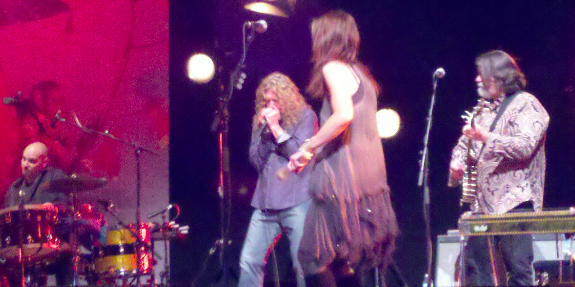
Glenn Hughes and Joe Bonamassa perform a secret gig in London for Black Country Communion's September 2010 album release. Photo by Christie Goodwin; used with permission of Noble PR.
The newly announced UK shows are:
Tuesday, July 26: Leeds O2 Academy
Tickets: £40.00 Standing; £45.00 Seated
Tickets for the above shows are also available through 24-hour box office at 0871 230 1101 or online at See Tickets or The Gig Cartel.
A special ticket pre-sale will be available to O2 Academy Priority subscribers beginning Wednesday, Feb. 2 at 9 a.m. GMT. To become an O2 Academy Priority customer, please register at www.o2blueroom.co.uk. Tickets will then go on sale to the general public at 9 a.m. GMT on Friday, Feb. 4.
It's quite possible that by the time of the shows, their second album will have been freshly released. Progress continues on the album today, with singer and bassist Glenn Hughes providing frequent updates via his Twitter page. Yesterday, he said he expected to be recording vocal parts along with guitarist Joe Bonamassa for the new album today. As was the case on some tracks on their debut album, they would be sharing vocals on the new album.
"I'm a really big supporter of having a couple singers," Hughes told LedZeppelinNews.com at the time of the first album release. "I've shared the stage with a few singers, but I think David Coverdale and Glenn Hughes set the mark in the '70s for the dual lead singer thing," said Hughes, referring to their days as bandmates in Deep Purple.
He continued, "I've always liked to be in bands where there are two singers. A lot of lead singers want that mic all the time. I think it's great having a different timbre, a different tone coming in. It switches gears to a different singer. I think it's great. Lennon and McCartney, baby!"
The UK appearances follow a seven-show tour of Germany from June 30 to July 14. Those previously announced dates are as follows:
Robert Plant eyes up Patty Griffin
during "Rich Woman" in New York: Mine eyes have seen the glory!
Robert Plant, it seems, does everything differently these days. When an artist plays Toronto one weekend, and New York the next, it is normal that New York is the one everyone talks about, even while the artist is in Toronto. For Robert Plant, who is playing New York this weekend to a wall of silence, last weekend's Toronto shows are again being talked about.
The Observer's Ed Vulliamy spent last weekend with Plant in Toronto talking in depth with Plant about his motivations for performing, how he gets to the shows, and the Wolverhampton Wanderers.
"There's no plan," Plant tells Vulliamy, "this band has a life of its own." Those are key words. When wondering what will Plant do, he is just as much in the dark as you are. Last week, I penned a piece chronicling his desire to write with Band of Joy after telling Rolling Stone he was done writing. The real answer to the question of what's next for Robert Plant lies in that answer: "There's no plan." And if that means Robert Plant is moving on from where his fans are musically, drifting out of significance, he understands that:
"The further I get into it, the harder it will be to get a gig in the Top Rank. I won't fit. If I continue doing this, it will mean obsolescence for me ... I'm just incredibly fortunate that my eyes and ears have been opened. I have to be honest with myself and remove as much of the repetition and fakery as is humanly possible."
Unlike other interviews, other comments, Plant is also more conciliatory, less dismissive, towards his time in Led Zeppelin:
"We were great when we were great. I was part of something magnificent which broke the Guinness Book of Records, but in the end, what are you going to get out of it? Who are you doing it for? You have to ask these questions: Who pays the piper, and what is valuable in this life? I don't want to scream 'Immigrant Song' every night for the rest of my life, and I'm not sure I could."
Comments like "who pays the piper" probably say more about why Robert Plant turned down huge money for a Led Zeppelin reunion. A tour the size of Zeppelin would be a machine grinding away at Plant's creative impulses. Besides, how would a reunited Zeppelin get to the gigs? Not, I suspect, by Plant's preferred method:
"It's all by bus. It's a great way to see America and a great way to meet interesting people. But most of all, I want to be on these kinds of terms with these kinds of people. There's no point in doing it any other way, and if I did, I'd feel uncomfortable. I've got a big name, but I've always wanted to be in a band, one of a band ... I do not want to arrive to join the band in a limo."
Plant is also less dismissive than he has been about other artists continuing to play their old songs, touring with 40-year-old music:
"It would become progressively more difficult to talk about music at a whist drive. All my colleagues that I've known and loved -- our lives have been lived in parallel for 40 years -- and you have to say: each to their own. People get off on what they want to get off on -- I'm not going to tell anyone how to live ..."
Band of Joy in Ann Arbor, Mich.: Robert Plant, Buddy Miller,
Byron House, Marco Giovino, Darrell Scott, Patty Griffin.
Photo by Wyatt Brake
Leaving aside his comments, direct or indirect, about Led Zeppelin, Plant has a lot to say about his Band of Joy as well.
"I wonder sometimes, how did I get into this family of people? Sometimes I feel as though I'm not contributing so much as getting away with it ... this band has a life of its own. It's breaking down all the terminologies; all the terms that apply to different genres are being torn asunder. ...
"It's about contribution. Everyone is throwing themselves into this abstraction called Band of Joy, and no one knows what it is. But we know how to find it, and we go looking. I asked [manager Nicola Powell] if my rambling between songs on stage is getting too obscure. She says no, it's just about mad enough to capture the spirit of the thing."
Why, at his age, does Robert Plant keep doing it at all when he could easily retire to the Black Country, watching the Wolverhampton Wanderers and minding the legacy of Led Zeppelin?
"I would say it was restlessness if it was not something else, which is inquisitive curiosity and the need to challenge myself. It's a two-dimensional gig being a singer, and you can get lost in your own tedium and repetition."
Plant's inability to get lost in tedium and repetition is what fans both love and hate about him. It explains the great moments in his career, and it also explains why Led Zeppelin didn't stop progressing after Led Zeppelin II -- or after their fourth album.
It also explains why he is riding the buses with Buddy Miller and Patty Griffin and not jetting around the world with Led Zeppelin; why he is doing two nights at the Beacon Theatre and not seven at Madison Square Garden; why "Rock and Roll" is now a bluegrass number.
The Band of Joy is getting better as well, Plant tells Vulliamy. "Something went up a notch in Ann Arbor," the singer says, referring to the Michigan concert immediately before the pair of Toronto shows. It continued into the Toronto show, Vulliamy writes:
"The concerts are an eclectic mix pulled together by the charm and force of Mr. Plant's personality, the wonder of his voice and his spirited band ..."
One of the better stories and interviews I've seen with Robert Plant landed today in the Wall Street Journal. Heading into New York for two shows this weekend, Plant talked to the newspaper's Jim Fusilli about the progress of his Band of Joy.
Recordings of the first Band of Joy show in Memphis immediately hit the Internet last July. Listening to it, I thought, Not for me. But by December, when I watched part of the BBC Electric Proms broadcast, it was clear either the show was much better or I had acclimatized to what Plant was doing.
It turns out the shows were better. Says Plant:
"I think we were masking a whole lot of nerves. It was great, though. It started becoming a bit more mysterious on the second and third nights."
The "project," as Plant refers to it, is ever evolving. During soundcheck the band sits in a circle and toys with arrangements. It's all part of the "workshop feel" of the American music scene at present, says Plant. Making the obvious reference that many reviewers -- including myself -- have made, he compares Band of Joy to Led Zeppelin III:
"The two projects have some similarities over 40 years: the spirit of the '70s."